Reviews are independent. Prices are indicative (SGD) and change often — always check the latest price before buying. We may earn a commission from some links.
A Philips dehumidifier is a sensible buy for any Singapore home fighting our year-round humidity, damp cupboards and the mould that follows, and Philips’ range has grown into a genuine rival to the usual Novita and Europace picks. This guide covers the Philips models most worth buying here, spanning compact bedroom units up to higher-capacity machines for a whole HDB flat, and explains how much water extraction you actually need locally.
We judged these on daily water extraction, tank size, energy use, noise and how well they cope with our persistent 70-plus percent humidity. It’s written for homeowners battling mould on walls and wardrobes, families protecting electronics and clothing, and anyone comparing a Philips dehumidifier against a Novita dehumidifier or a Sterra unit before spending their SGD. In our climate a dehumidifier is less a luxury than quiet insurance — it keeps wardrobes, leather goods, cameras and musical instruments from going mouldy during long wet spells when the windows stay shut. Our prices are indicative SGD ranges that change often, so use them as a guide and check the latest price before you buy.
What to look for in Singapore
- Daily extraction rate in litres — Singapore’s humidity is relentless, so aim for a capacity that matches your room size rather than the smallest unit.
- Tank capacity plus a continuous-drain option, so you can run it into a floor trap without emptying the tank several times a day.
- A built-in humidistat that holds a target humidity (around 50 to 55 percent) automatically instead of running non-stop.
- Laundry or clothes-drying mode, genuinely useful in flats with no outdoor drying space during wet spells.
- Energy efficiency, since a dehumidifier that runs for hours daily adds up on the utility bill.
- Noise level for bedroom use, ideally with a quiet night setting.
- Portability — castors or a carry handle to move it between the bedroom, store room and wardrobe area.
- Local warranty and easy filter access, so servicing and cleaning are straightforward in Singapore.
At a glance
| Model | Best for | Key spec | Indicative price | Rating |
|---|---|---|---|---|
| Philips 5000 Series — Editor’s Choice | Whole flat | High extraction, app control | $500–$800 | ★★★★★ |
| Philips 3000 Series | Living rooms | Mid extraction, laundry mode | $350–$550 | ★★★★☆ |
| Philips 2000 Series | Bedrooms / value | Compact, quiet | $250–$400 | ★★★★☆ |
| Philips Compact Dehumidifier | Wardrobes / small rooms | Low capacity, portable | $150–$280 | ★★★★☆ |
The picks
Editor’s Choice
Philips 5000 Series Dehumidifier
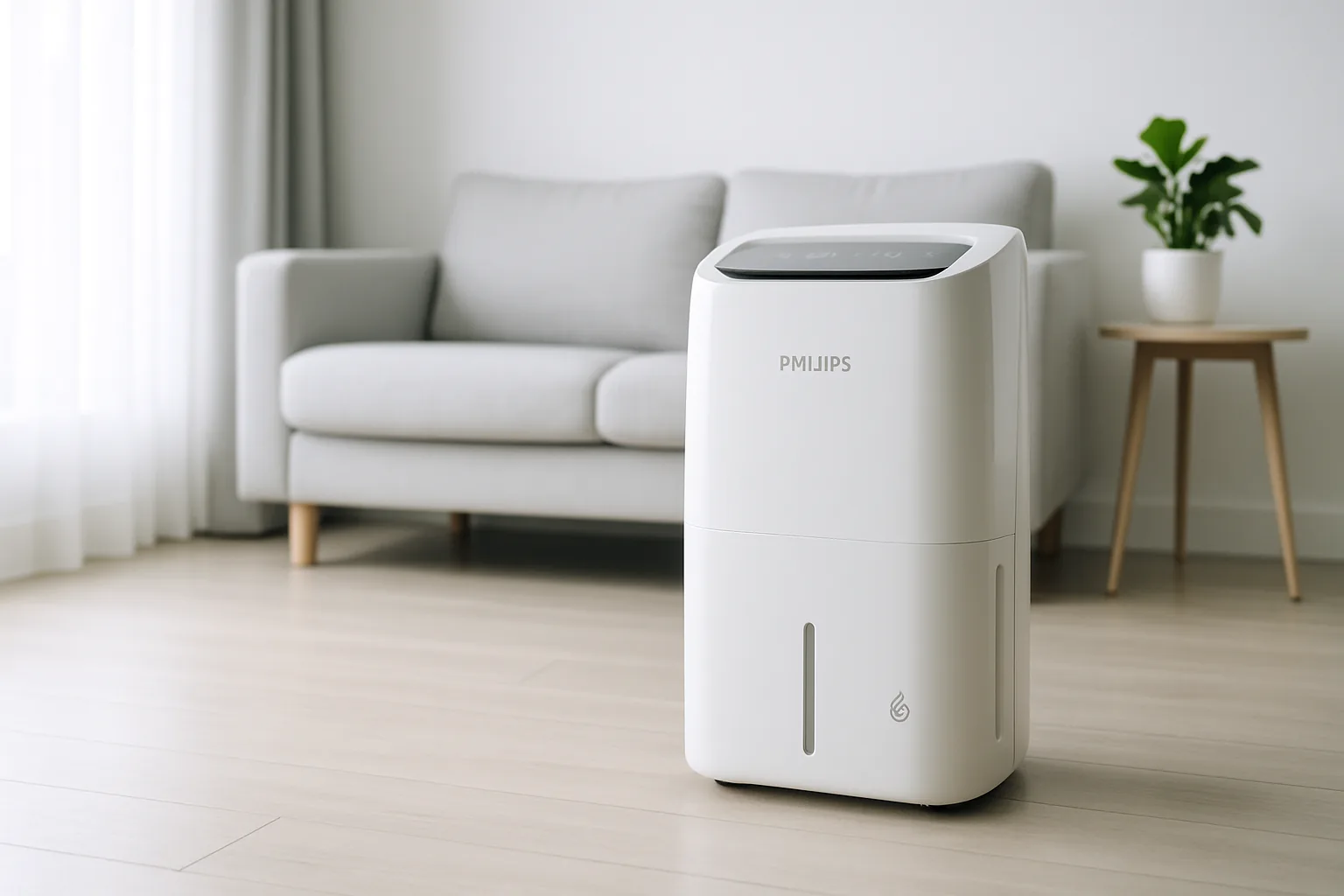
The 5000 Series has the extraction capacity and continuous-drain option to handle a whole HDB flat or a damp condo, with app control and a smart humidistat. It’s the Philips to buy if mould and damp are a real, ongoing problem. The continuous-drain option means you can run it into a floor trap and forget about emptying the tank, and the auto humidistat stops it running needlessly once your target humidity is reached.
Pros
- High daily water extraction
- Continuous drain and app control
- Effective humidistat auto mode
Cons
- Larger and heavier
- Premium price
Best for living rooms
Philips 3000 Series Dehumidifier
A balanced mid-range unit with a useful laundry mode for drying clothes indoors during wet spells. It suits a living-dining area or a larger bedroom and won’t dominate the room.
Pros
- Good extraction for the size
- Handy clothes-drying mode
- Reasonable running cost
Cons
- Tank needs regular emptying without drain hose
- Mid-range price
Best Value
Philips 2000 Series Dehumidifier
Compact, quiet and affordable, the 2000 Series is ideal for a bedroom or study where you want to control damp overnight. A sensible entry point into the Philips range.
Pros
- Affordable and quiet
- Compact footprint
- Simple to use
Cons
- Lower extraction capacity
- Smaller tank
Best for wardrobes
Philips Compact Dehumidifier
A small, portable unit for wardrobes, store rooms and damp corners where mould loves to form. It’s not for whole rooms, but for targeted damp spots it’s cheap and effective.
Pros
- Very portable
- Low cost
- Good for enclosed damp spaces
Cons
- Small capacity only
- Not for large rooms
The verdict
For a whole Singapore flat the Philips 5000 Series is the strongest pick, while the 2000 Series is the value choice for keeping a single bedroom dry. For a persistent damp corner or wardrobe, the Compact unit is a cheap, targeted fix worth adding alongside a main dehumidifier.
Frequently asked questions
What size dehumidifier do I need for a HDB flat?
For a single bedroom, a compact 2000 Series unit is enough. For a living-dining area choose the 3000 Series, and for a whole flat or a home with persistent mould, the higher-capacity 5000 Series with continuous drain is the safest bet in our humidity.
Does a Philips dehumidifier stop mould?
It helps significantly. Holding indoor humidity around 50 to 55 percent removes the moisture mould needs to grow, protecting walls, wardrobes and electronics. Pair it with good ventilation and wipe existing mould before running it.
How much does it cost to run daily in Singapore?
It depends on capacity and hours, but a dehumidifier running several hours a day is a noticeable but manageable addition to the power bill. Using the humidistat auto mode instead of running non-stop keeps the cost down.
Philips or Novita or Sterra — which is better?
A Novita dehumidifier has strong local brand presence and service, Sterra pushes design and value, while Philips balances reliable extraction with a clean interface and app control. For most homes it comes down to the capacity and features you need rather than the badge.
Can I use it to dry laundry indoors?
Yes, the 3000 and 5000 Series have a laundry or clothes-drying mode that speeds up indoor drying during wet weather when outdoor drying isn’t possible. It’s one of the most useful features for flats without a covered drying area. Pointing the outlet towards your drying rack and closing the room off makes it noticeably faster and helps avoid that damp, musty smell on clothes.
Related guides
Planning a smarter home?
Tell us your space and budget — we’ll point you to the right devices, or connect you with a supplier.

