Reviews are independent. Prices are indicative (SGD) and change often — always check the latest price before buying. We may earn a commission from some links.
LG is a name Singapore households know and trust across fridges, washers and air treatment, so it is natural that its dehumidifiers attract attention from buyers who want a reliable brand with proper local service behind it. In our climate, where relative humidity sits high all year and damp brings mould on walls, musty wardrobes and clammy bedding, a dependable dehumidifier is less a luxury than a piece of everyday household kit. LG positions its units as efficient, quiet and well-built, aimed at people who will run them for hours at a stretch.
The question for a Singapore buyer is which capacity and features actually suit their home, since a bedroom and an open-plan condo have very different needs. Extraction capacity, energy efficiency, tank size, running noise and the availability of continuous drainage all shape how well a dehumidifier fits your flat and how much it costs to run. This guide explains what to look for in an LG dehumidifier, weighs up the models that make sense locally, and gives the honest trade-offs so you buy a machine that keeps damp under control without wasting energy or disturbing your sleep.
What to look for in Singapore
- Match the daily extraction capacity to your space, since an open-plan Singapore living area needs far more than a single bedroom.
- Look for a built-in humidistat so the unit holds a target humidity rather than running constantly and wasting electricity.
- Prioritise energy efficiency, as a dehumidifier running daily in our climate adds up noticeably on the power bill.
- Check the noise level if it will run overnight, because a loud compressor unit disrupts sleep in a bedroom.
- Prefer a model with a continuous drainage option so it can run into a floor drain without constant tank emptying.
- Consider tank size against how often you will empty it, since high humidity fills tanks quickly here.
- A laundry or clothes-dry mode is genuinely useful in Singapore flats that lack outdoor drying space.
- Look for auto-restart and full-tank shutoff for safe, unattended running over long periods.
At a glance
| Model | Best for | Key spec | Indicative price | Rating |
|---|---|---|---|---|
| LG Inverter Dehumidifier (mid) — Editor’s Choice | Overall | Efficient inverter, humidistat | $450–$650 | ★★★★★ |
| LG Compact Dehumidifier — Best Value | Bedrooms | Quiet, moderate capacity | $300–$450 | ★★★★☆ |
| LG High-Capacity Dehumidifier — Best for Large Homes | Big spaces | High extraction, continuous drain | $550–$800 | ★★★★☆ |
| LG Dual Inverter Quiet — Best for Bedrooms | Overnight use | Low noise, energy saving | $500–$700 | ★★★★★ |
| LG Smart ThinQ Dehumidifier — Premium | App control | Wi-Fi app, humidistat | $550–$800 | ★★★★☆ |
The picks
Editor’s Choice
LG Inverter Dehumidifier
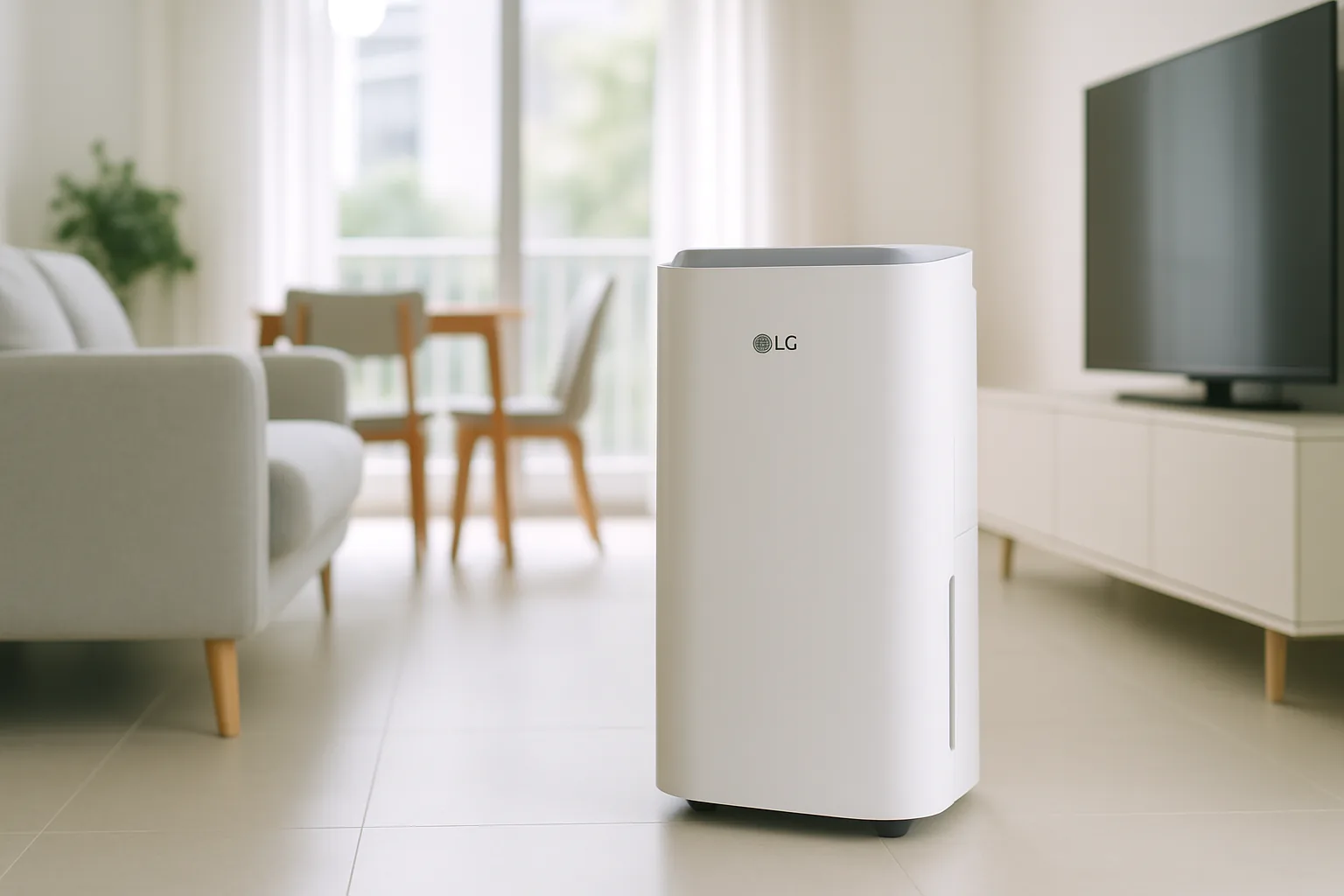
LG’s mid-capacity inverter dehumidifier is the pick for most Singapore homes, combining efficient inverter operation with a humidistat that holds your target humidity rather than running flat out. It keeps a living area or a couple of bedrooms comfortably dry, runs quietly for its output, and offers continuous drainage for hands-free use. The inverter design helps keep running costs down over the long hours these machines work here. For a well-built, efficient all-rounder from a trusted brand, it is the natural default choice.
Pros
- Efficient inverter operation
- Humidistat holds target level
- Continuous drain option
Cons
- Pricier than budget brands
- Fairly bulky
Best Value
LG Compact Dehumidifier
For a single bedroom or study, LG’s compact dehumidifier delivers dependable damp control at a more accessible price. It runs quietly enough for overnight use, keeps a modest room dry, and is easy to move where it is needed. The smaller tank means more frequent emptying during very humid spells, but for a single space it is a sensible, wallet-friendlier way into the brand. Households often buy one per bedroom rather than a single large unit for the whole flat.
Pros
- More affordable LG option
- Quiet enough for bedrooms
- Easy to move around
Cons
- Smaller tank
- Not for large open spaces
Best for X
LG Dual Inverter Quiet
If a quiet night’s sleep is the priority, LG’s dual inverter quiet model is engineered to run at low noise while still pulling meaningful moisture from the air. The energy-saving inverter keeps power use modest through the long overnight hours, and the humidistat stops it cycling harder than needed. It costs a little more, but for a bedroom where compressor drone would keep you awake, the low noise is worth it. A refined choice for light sleepers battling humidity at night.
Pros
- Very quiet operation
- Energy-saving inverter
- Good for overnight use
Cons
- Higher price for the quiet tech
- Capacity moderate, not maximum
Premium
LG Smart ThinQ Dehumidifier
For a connected home, LG’s ThinQ-enabled dehumidifier lets you set humidity targets, schedule operation and monitor status from your phone, so you can switch it on before you get home to a fresh, dry flat. It keeps the inverter efficiency, humidistat and drainage options of the standard range while adding genuine app convenience. The ThinQ app is polished and reliable. It is a premium spend, but for anyone already running an LG smart-home setup it slots in neatly and adds real day-to-day ease.
Pros
- Full app control and scheduling
- Efficient and well-featured
- Fits LG smart-home setups
Cons
- Premium price
- Needs stable Wi-Fi
The verdict
The LG Inverter Dehumidifier is the best all-round choice for most Singapore homes, balancing efficiency, quiet running and features, while the compact model suits single bedrooms. Match the capacity to your space and use continuous drainage where possible to keep damp and mould firmly in check.
Frequently asked questions
What size LG dehumidifier do I need in Singapore?
A single bedroom is well served by a compact unit, a living area or a couple of bedrooms suits a mid-capacity inverter model, and a large open-plan condo or landed home needs a high-capacity machine. Because Singapore’s baseline humidity is so high, it is wise to slightly over-size rather than under-size, as a struggling small unit runs constantly and still cannot keep up. Consider one larger unit for open spaces or several smaller ones across separate rooms.
Are LG inverter dehumidifiers more energy efficient?
Yes, inverter models adjust their compressor speed to match demand rather than switching fully on and off, which generally makes them more efficient and quieter over the long hours these machines run in Singapore. Combined with a humidistat that holds your target humidity, an inverter unit avoids wasting power once the air is dry. Over a year of daily use, the efficiency gain can offset a good part of the higher upfront price.
How often will I need to empty the tank?
In our humidity a dehumidifier fills its tank fast, often once or twice a day for a smaller unit in a damp room. LG models with a continuous drainage option let you run a hose to a floor drain or bathroom so you never empty the tank by hand, which is the most convenient way to run one. If you cannot use continuous drainage, choose a model with a larger tank to reduce refilling.
Can an LG dehumidifier run quietly overnight in a bedroom?
LG’s inverter and dual inverter models are designed to run at low noise, and the quiet-focused units in particular are well suited to overnight bedroom use. A humidistat also means the machine backs off once the room reaches your target humidity rather than droning at full power all night. If overnight quiet matters, choose one of the inverter models rather than a basic compressor unit, which will be noticeably louder.
Will an LG dehumidifier help with mould and musty smells?
Yes, keeping indoor humidity around fifty to sixty percent makes it much harder for mould to grow and clears the musty smell that damp brings to Singapore homes. Used in enclosed spaces like bedrooms, wardrobes and store rooms, an LG dehumidifier controls the moisture that mould needs to thrive. You will still need to clean any existing mould, but maintaining low humidity stops it returning and protects clothes, furniture and walls.
Related guides
Planning a smarter home?
Tell us your space and budget — we’ll point you to the right devices, or connect you with a supplier.